




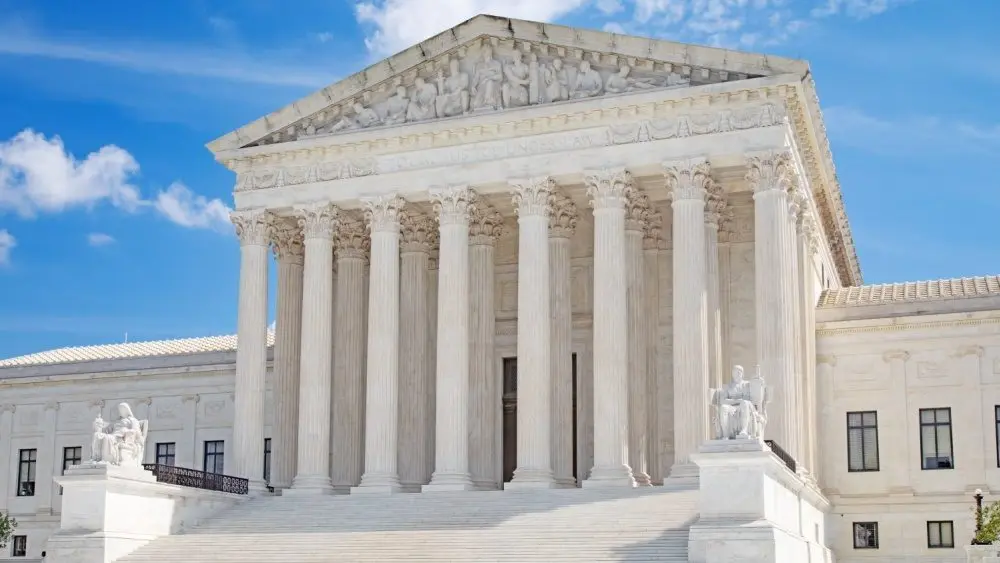
In a narrowly divided 5-4 vote, the U.S. Supreme Court blocked Alabama’s effort to reinstate the death sentence of Joseph Clifton Smith, after deciding not to settle a broader dispute over how IQ scores should be evaluated in death penalty cases.
The 55-year-old inmate was sentenced to death for the 1997 killing of Durk Van Dam with a hammer during a robbery in Mobile County, Alabama. Prosecutors said Smith stole the victim’s boots, tools, and $140 before leaving his body in a wooded area.
A federal judge had overturned Smith’s death sentence in 2021, describing the matter as a “close case.” The judge also pointed to evidence of long-standing developmental and adaptive impairments, including childhood abuse, academic struggles, and a diagnosis in middle school that classified him as having mild intellectual disability. The 11th U.S. Circuit Court of Appeals later upheld that ruling.
Alabam’s case centered on whether Smith is intellectually disabled, which would make him ineligible for execution under the Supreme Court’s 2002 ruling in Atkins v. Virginia. Smith underwent five IQ tests over the years, with four scores landing in the low-to-mid 70s. Although Alabama argued none of the scores fell below 70, lower courts concluded that the margin of error on his lowest result — a 72 — could place his actual IQ under that threshold.
On Thursday, the Supreme Court dismissed Alabama’s appeal in an unsigned opinion, saying the case had been “improvidently granted,” meaning the justices decided they should not have agreed to hear it. Justice Sonia Sotomayor, joined by Justice Ketanji Brown Jackson, wrote separately to explain that the court was not the right venue to resolve the broader legal question about weighing multiple IQ scores because the issue had not been fully addressed in lower courts.
“There is no reason for this Court to leapfrog the experts, state courts and federal lower courts to provide conclusive guidance at this level of detail in the first instance,” Sotomayor wrote. “Thus, for the reasons given above, the Court is correct today to dismiss this case as improvidently granted.”
Conservative Justices Clarence Thomas and Samuel Alito dissented. Thomas argued the court was effectively rewarding Smith’s attempts to prove he lacked the intellectual capacity to face execution. Alito criticized the majority for leaving unresolved what he called a major legal issue in death penalty cases. “Instead, the Court shies away from its obligation to provide workable rules for capital cases,” Alito wrote. “In doing so, the Court disservices its own death penalty jurisprudence, States’ criminal-justice systems, lower courts and victims of horrific murders.”
Smith’s attorney, Kacey Keeton, said the ruling means her client will be removed from death row and resentenced in state court. “Joseph Smith has spent decades on death row while courts examined whether the Constitution protects him. Today, it does,” Keeton said.
Editorial credit: Fedor Selivanov / Shutterstock.com